ATV battery CCA: how many cold cranking amps do you need?
Understand ATV battery cold cranking amps, compare CCA with CA and amp-hours, and match replacement starting power to the OEM application.
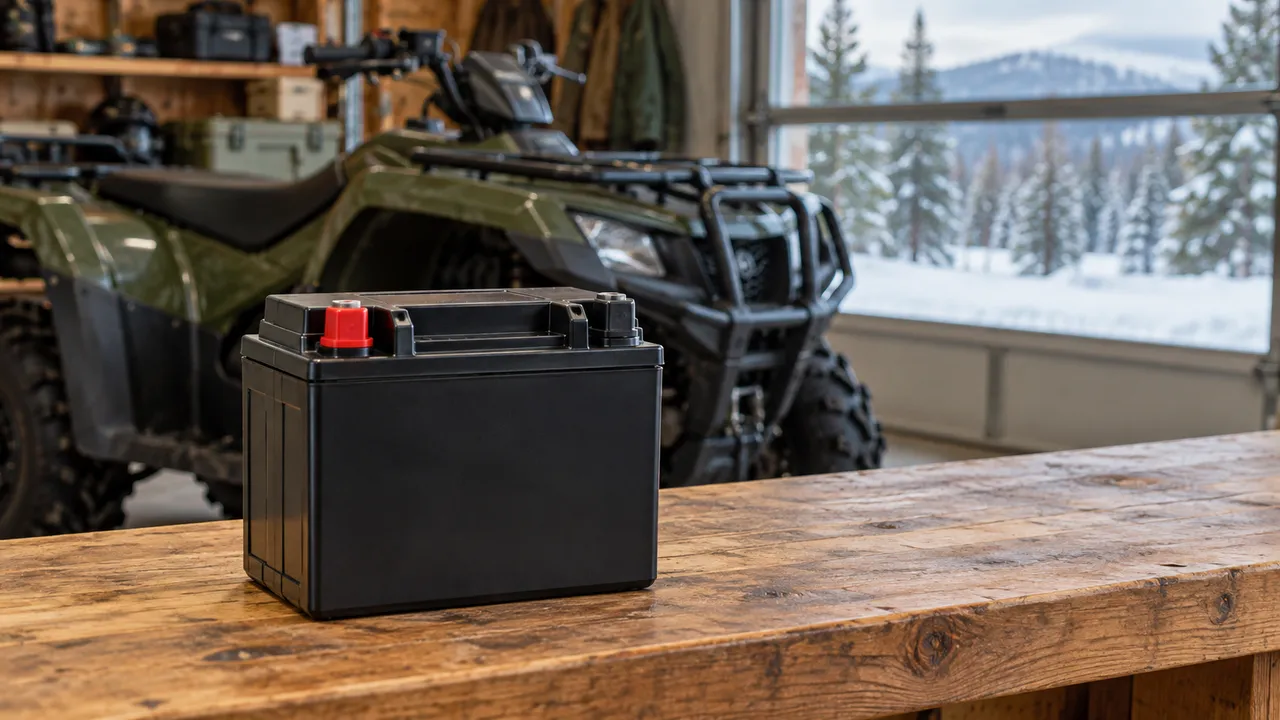
Your ATV battery needs the starting rating specified for its exact application, along with the correct voltage, capacity, case and terminals. CCA measures cold starting performance under a defined test. Compare ratings on the same standard, and do not substitute peak lithium cranking current or amp-hours for the required CCA.
What cold cranking amps mean
For the familiar 12-volt lead-acid CCA definition, the rating describes current delivered for 30 seconds at 0°F while maintaining at least 7.2 volts. That is a standardized comparison condition, not a target voltage for operating your ATV or a recommended cranking duration.
The number is useful when comparing batteries tested on the same basis. Read the actual product specification rather than assuming two marketplace headlines use an identical test. If a seller provides only an unspecified “cranking amps” figure, request the test standard before treating it as CCA.
Find the required CCA for your stock OEM battery
Start with the OEM battery specification or a documented replacement application for the exact year and trim. Engine size alone is insufficient: starter design and vehicle configuration also matter. There is no single minimum CCA suitable for every ATV.
Use the finder to identify battery codes, then compare the listed products’ specifications with the vehicle requirements. If the manual gives an OEM part number rather than a CCA minimum, preserve that application requirement and seek a documented equivalent. Do not fill an absent rating with a guess.
Treat the currently installed battery as a cross-check. A previous owner may have chosen a substitute rather than the stock battery. Record its label and dimensions, including battery box clearance, but establish the correct OEM battery application independently before ordering.
CCA vs. CA vs. amp-hours
Starting performance and stored capacity answer different questions. A winch or accessory discussion may involve capacity, while a cold-start comparison involves a starting rating. Neither figure replaces the other. Write down the unit and test basis beside each number when comparing listings.
Ah ratings also need their stated discharge conditions to be meaningful. Two products with a similar case and impressive advertising can have quite different published capacity. Compare the manufacturer’s data sheet, not just the battery code printed in a listing title.
| Rating | What to compare |
|---|---|
| CCA | Cold starting current using the specified test standard. |
| CA or other cranking rating | Temperature, duration and voltage threshold; not automatically CCA. |
| Ah | Capacity at the stated discharge rate and conditions. |
| Peak current | Manufacturer-defined short-duration output; not a CCA substitute. |
| Voltage | The nominal voltage required by the vehicle electrical system. |
Is higher CCA better for an ATV battery?
A compatible battery with more available starting current does not force all of its rated current through the starter. The electrical load draws current according to the circuit conditions. However, a bigger advertised number alone does not make a battery a better replacement.
Compare products only after checking voltage, physical fit, polarity, capacity and charging compatibility. A higher-CCA case that does not fit the hold-down or requires stretched cables is unsuitable. AGM is a lead-acid design; replacing a stock AGM battery with lithium still requires a documented application and charging match.
For example, keep a comparison sheet with columns for dimensions, terminal positions, chemistry, Ah, starting test and warranty. Eliminate incompatible candidates first. Then compare the remaining products for the climate and riding pattern that matter to you.
Compare lithium starting ratings carefully
A lithium listing may advertise peak amps, a proprietary cranking measure or a lead-acid-equivalent figure. Those descriptions should not be read as a standardized CCA result unless the manufacturer explicitly documents that test. Ask for application approval and actual specifications.
Also check cold-start instructions, low-temperature charging restrictions and protection-system behavior for the exact lithium product. A large current figure does not explain these operating limits. Compare the whole approved battery system, including any charger or mounting hardware it requires.
Separate low CCA from a starting fault
Slow cranking is a reason to inspect and test, not proof that the original battery rating is too small. Check charge state and connections before shopping for a higher figure. A compatible battery test can help distinguish a discharged battery from one that no longer performs adequately.
If the battery meets its test requirements but the ATV still struggles, investigate the starting circuit and mechanical condition. Increasing the advertised CCA is not a repair for a loose terminal or faulty starter. Keep the original application specification as the baseline while diagnosing the symptom.
Frequently asked questions
How many CCA does an ATV battery need?
Use the specification or documented replacement application for the exact make, model, year and trim. A universal figure based only on engine displacement is not reliable.
Can I install a battery with higher CCA?
It can be appropriate if every other fitment and electrical requirement is met. The higher starting rating does not excuse an incorrect case, terminals, voltage, chemistry or capacity.
Does a higher Ah battery have higher CCA?
Not necessarily. Capacity and cold starting performance are separate specifications. Read both ratings for the actual battery model instead of deriving one from the other.
Are lithium peak amps the same as CCA?
No. Compare the documented test conditions. A peak-current headline is not evidence that the battery meets the ATV’s specified cold cranking requirement.
Bring it back to your ride
Find your ATV in the catalog, browse battery size references or explore the other field guides.