ATV battery voltage: resting, cranking and charging readings
Understand ATV battery voltage at rest, during starting and with the engine running. Learn why chemistry, temperature and test conditions change the meaning.
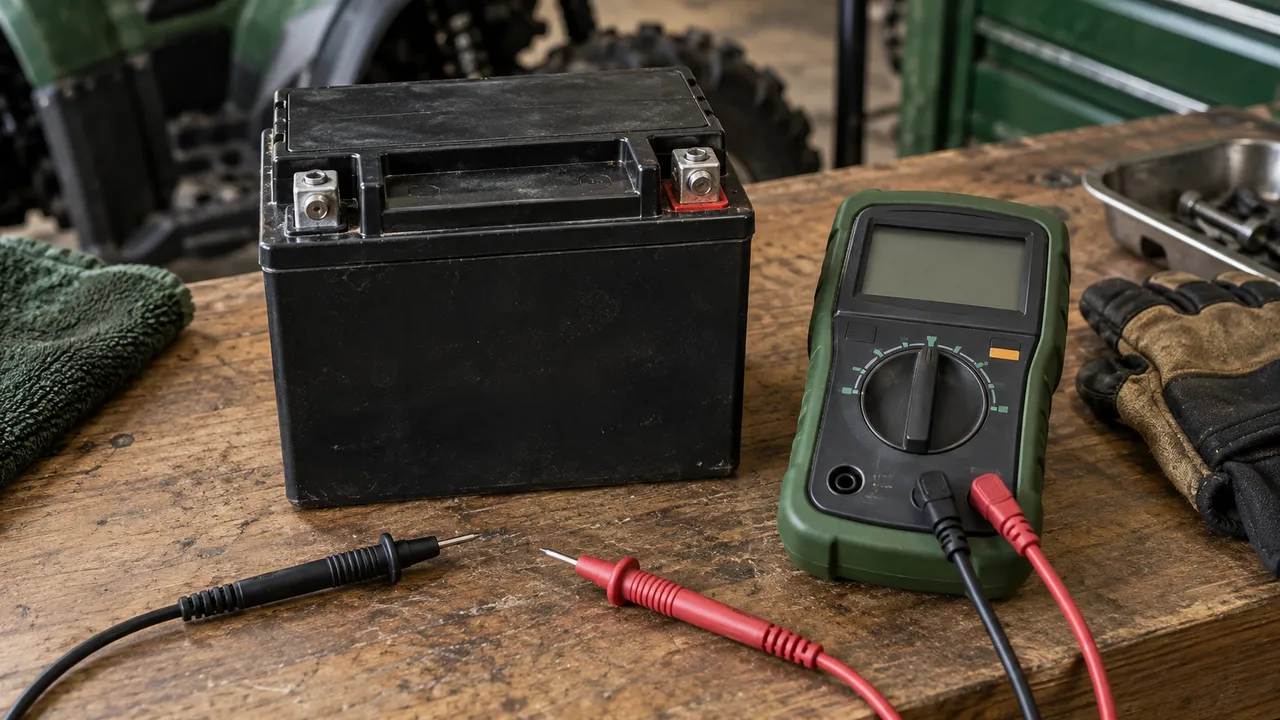
ATV battery voltage must be interpreted under the right conditions: at rest, during cranking or while charging. Many gasoline ATVs use a nominal 12-volt starting battery, but the measured value changes with charge state and operation. Compare your reading with the exact battery and vehicle specifications rather than using one universal cutoff.
Nominal voltage is different from measured voltage
The voltage printed on a battery identifies the application; it is not a promise that the meter will show that exact value. A charged battery at rest, a battery supplying the starter and a battery receiving charge can all produce different readings.
Confirm the voltage in your ATV owner’s manual and on the battery label. This guide concerns gasoline ATV starting batteries. Youth electric ATVs and other electric vehicles can have different traction-battery systems, which need their own documentation and charging equipment.
Do not select a higher-voltage replacement to solve slow starting. The vehicle electrical system determines the required nominal voltage. Starting performance also depends on battery capacity, condition, connections and starter demand.
Read resting voltage after the battery stabilizes
Resting, or open-circuit, voltage is measured without charging or a significant load. Switch off the ignition and accessories, remove the external charger as instructed and allow the battery to stabilize. Recent charging can make a reading look better than the battery’s settled condition.
Use the battery maker’s chart for the actual chemistry and temperature. Conventional lead-acid and AGM values can differ, while a lithium battery’s voltage behavior needs its own interpretation. A chart for one type cannot reliably assign a charge percentage to another.
For example, the 2024 Polaris Sportsman 850 / XP 1000 Touring manual specifies recharging its sealed battery below 12.6 volts. A separate Polaris battery-charging instruction uses 12.8 volts for its application. These are application instructions, not interchangeable limits for every ATV.
Cranking voltage shows the battery under demand
The starter creates a much heavier electrical load than a dashboard or small light. Terminal voltage normally changes during a start attempt. A battery can power the display yet struggle to deliver starting current.
Record cranking behavior along with voltage: how quickly the engine turns, whether the display resets and whether the symptom changes after charging. Use a manual-specific test limit and starter-duration instruction. Temperature and the test method affect interpretation.
A low cranking reading calls for a battery performance test and cable checks. It does not automatically prove the battery is defective; excessive starter demand or a poor electrical connection can complicate the result.
Running voltage checks the charging system
A running-voltage test asks whether the vehicle charging system meets its specified output conditions. Take the measurement at the battery terminals with the battery connected, using the engine speed and electrical load stated in the service manual.
Compare the result with the vehicle’s allowed range and the battery manufacturer’s charging requirements. Too little output can leave the battery discharged; output above the approved limit requires attention too. An upgraded battery does not remove the need to check regulator compatibility.
An idle measurement, a dashboard display and a reading taken directly at the battery may not be equivalent. Note where you measured and repeat the test consistently before diagnosing a component.
| Measurement | Question it answers | Important condition |
|---|---|---|
| Resting voltage | Is the charge condition consistent with the battery chart? | Stabilized battery, correct chemistry and temperature. |
| Cranking voltage | How does voltage respond during starting? | Specified test method and starter interval. |
| Running voltage | Does charging output meet vehicle requirements? | Specified engine speed and electrical load. |
| Cable voltage drop | Is a connection losing voltage under load? | Qualified test of the relevant circuit. |
Avoid common voltage-reading mistakes
Select DC voltage, connect the leads to the correct meter sockets and read at clean battery terminals. Record the charger status and operating condition. Comparing yesterday’s post-charge reading with today’s loaded reading can suggest a fault that the different conditions explain.
A decimal-place difference is less useful than a repeatable pattern. Look for whether the battery stabilizes after charging, supports normal cranking and receives correct running output. Use an appropriate tester when those results conflict.
Use the readings to choose the next repair
A low rested reading starts with charging and retesting. A charged battery that struggles under load needs a battery and starting-circuit check. A battery that passes but repeatedly loses charge points toward charging output, accessories or key-off drain.
Keep a short measurement log with the battery code, temperature, test condition and result. It gives a technician a useful starting point and helps confirm that the eventual repair corrected the original symptom.
Frequently asked questions
Are all ATV batteries 12 volts?
Many gasoline ATV starting batteries are nominally 12 volts. Confirm your vehicle specification; an electric ATV traction battery is a different application.
What voltage means my ATV battery is dead?
There is no single universal reading for every battery chemistry and test condition. A low reading may mean discharged rather than permanently failed. Charge and test according to the battery instructions.
Is a good resting voltage enough to start the ATV?
No. Resting voltage does not establish how well the battery supplies starter current. A performance test helps identify a battery that appears charged but fails under load.
Should voltage rise when the engine starts?
Evaluate running output using the service manual’s engine speed and load conditions. A single comparison at idle does not fully establish charging-system performance.
Bring it back to your ride
Find your ATV in the catalog, browse battery size references or explore the other field guides.