ATV battery charger buying guide: voltage, amps and battery type
Choose an ATV battery charger or maintainer by voltage, chemistry, capacity, charging current and connector compatibility before comparing features.
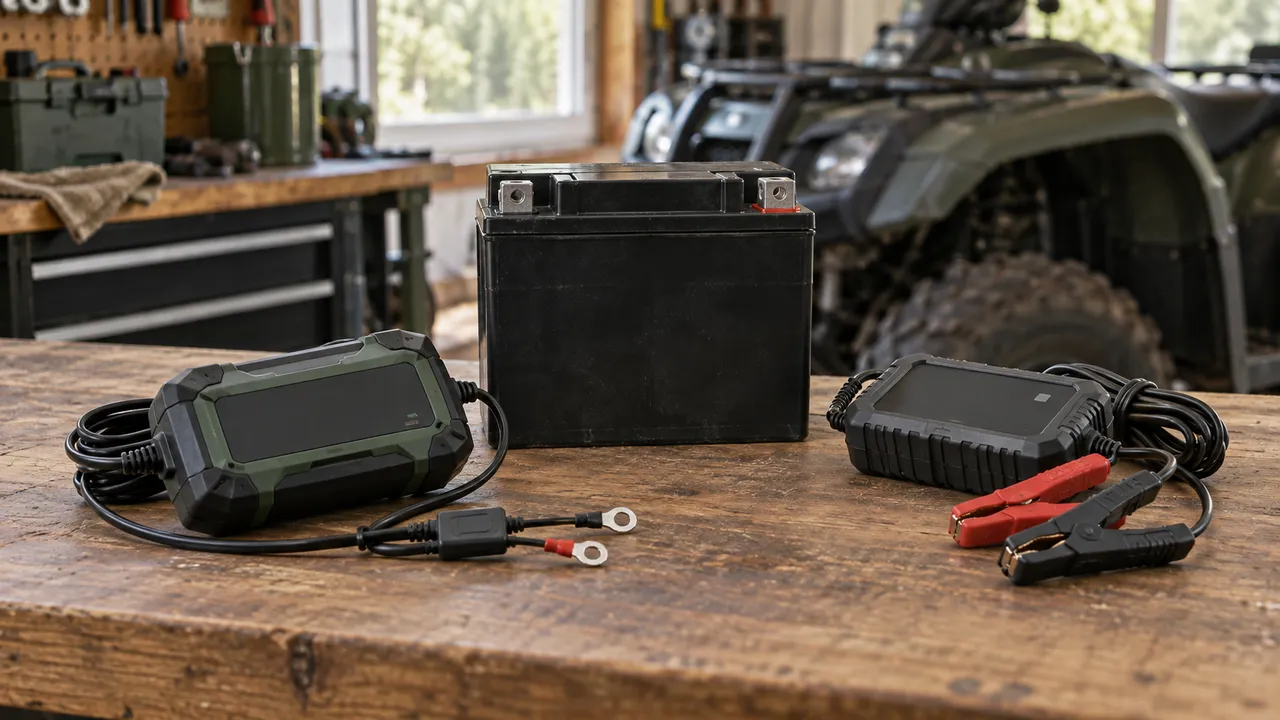
Choose an ATV battery charger that supports your battery’s voltage, chemistry, capacity and specified charging current. Then check the connector, storage-maintenance approval and installation environment. A charger with more amps or more modes is useful only when those features suit the battery you own.
Chargers and maintainers to consider
Choose by battery chemistry, capacity and permitted charging current. The GENIUS1 offers selectable modes; the Junior 750mA and CTEK US 0.8 are lead-acid options. For lithium, confirm the battery maker approves the exact charger and temperature range.

NOCO GENIUS1
1A smart charger with 6V and 12V modes, including dedicated AGM and lithium settings. Best suited to owners who need more than one charging profile.
Shop on Amazon ↗
Battery Tender Junior 12V 750mA
Automatic 0.75A charger and maintainer for compatible 12V lead-acid, AGM and gel batteries. This 750mA model is not the lithium-selectable Junior.
Shop on Amazon ↗
CTEK US 0.8 (56-865)
0.8A automatic 12V lead-acid charger with a six-step cycle and float/pulse maintenance. A compact option for seasonal powersports storage.
Shop on Amazon ↗Start with the battery label, not a charger ranking
Write down the battery manufacturer, model, nominal voltage, chemistry and Ah capacity before shopping. Find its charging instructions as well as the vehicle owner’s manual. A marketplace title saying motorcycle, ATV or UTV charger does not settle the electrical match.
Identify what you need the equipment to do. Initial charging of a replacement battery, occasional recharging and maintaining a parked ATV are different jobs. A compact maintainer may suit storage, but its normal charging capability must still cover your battery if you also expect it to recharge after use.
Match voltage and chemistry before comparing features
Read the charger manual for the supported modes and batteries, rather than relying on a front-panel icon. Conventional lead-acid, AGM and lithium products may need different profiles. A lithium mode may also require a battery management system; check that condition against the actual battery.
NOCO, for example, separates ordinary 12V, AGM and lithium modes on its GENIUS range. That illustrates why a charger’s voltage label alone is incomplete. A battery maker may place additional restrictions on equipment that otherwise appears compatible.
| Check before purchase | What to confirm |
|---|---|
| Voltage | The battery voltage appears in the supported modes. |
| Chemistry | The exact battery type is supported and approved. |
| Capacity range | The battery Ah rating fits the charging specification. |
| Current | The output or selected setting meets battery limits. |
| Maintenance | The intended long-term use is permitted. |
| Connections | Clamps or harness match the approved installation. |
How many amps should an ATV battery charger provide?
Use the battery manufacturer’s specified charging current and the charger’s supported capacity range. There is no single setting for all ATV batteries. Check whether the listed current is fixed or selectable; buying a powerful charger is not useful if its lowest available setting exceeds your battery’s limits.
Charging speed also depends on starting charge level and the automatic cycle. A higher output does not make every part of that cycle faster. If you are choosing equipment for several vehicles, make a compatibility list for each battery instead of assuming the largest battery determines the right charger for all of them.
Battery maintainer versus trickle charger
For seasonal parking, look for an automatic smart maintainer approved for your battery and the intended duration. Read what happens when the battery is fully charged: does it use a suitable float profile or another approved maintenance cycle? Check fault indicators and whether it can remain connected. The words smart and tender alone do not establish compatibility.
Do not treat a continuous unregulated trickle charger as interchangeable with an approved automatic maintainer. Storage also involves vehicle electrical drain, temperature and inspection. Buying a maintainer does not remove the need to check the installation and battery periodically.
Choose useful connectors and garage features
Clamps are convenient for bench charging; an approved fused ring-terminal harness can help with an inaccessible battery. Check lead length, routing and connector polarity. An SAE connector or existing vehicle port still needs a compatibility check: similar-looking plugs are not proof of matching polarity. Reverse-polarity protection does not replace checking the connection.
Consider where the charger will sit and whether its cord reaches a suitable outlet without strained cables. Match its environmental rating to that location, keep leads clear of moving parts and make the display easy to inspect. Weather resistance does not permit every outdoor installation or immersion.
Clear fault indicators, accessible instructions and replacement leads are practical buying criteria. Compare warranty and support for the exact model. You do not need a display full of additional modes if one clearly documented charging profile serves your ATV.
Read recovery-mode restrictions before you buy
Repair, desulfation and force modes need separate scrutiny. They are not ordinary charging settings or proof that a failed battery can be restored. Shorai specifically prohibits automatic desulfation and related recovery modes that cannot be disabled on chargers used for its batteries.
If the battery is deeply discharged, follow its manufacturer’s diagnostic or recovery instructions. Do not select a bypass mode simply because a smart charger refuses to begin. A damaged battery needs inspection, and some lithium products require a particular response to a protection-system shutdown.
Make your final comparison from documented matches, then price and convenience. Keep both manuals with the equipment so the next person using the charger knows which mode and connection are appropriate.
Frequently asked questions
Can a car battery charger charge an ATV battery?
Only when its voltage, chemistry, capacity range and available current settings meet the ATV battery’s instructions. Some automotive equipment cannot provide an appropriate setting for a small powersports battery.
Is a lithium charger suitable for AGM?
A dedicated lithium profile is not automatically appropriate for AGM. A multi-mode charger may support both, but select the documented mode for the battery actually connected.
Can I use one charger for several ATVs?
Yes, if it is compatible with every battery and you select the appropriate settings for each. Compare each battery’s voltage, chemistry, capacity and current limits separately.
Should I buy a charger with a repair mode?
Choose compatibility with normal charging first. Repair modes have separate restrictions and cannot guarantee restoration. Do not use one on a battery whose manufacturer prohibits it.
Bring it back to your ride
Find your ATV in the catalog, browse battery size references or explore the other field guides.