Best ATV trickle chargers: smart maintainers for battery storage
Compare NOCO, Battery Tender and CTEK ATV trickle chargers. Choose an automatic battery maintainer for AGM, lead-acid or approved lithium batteries.
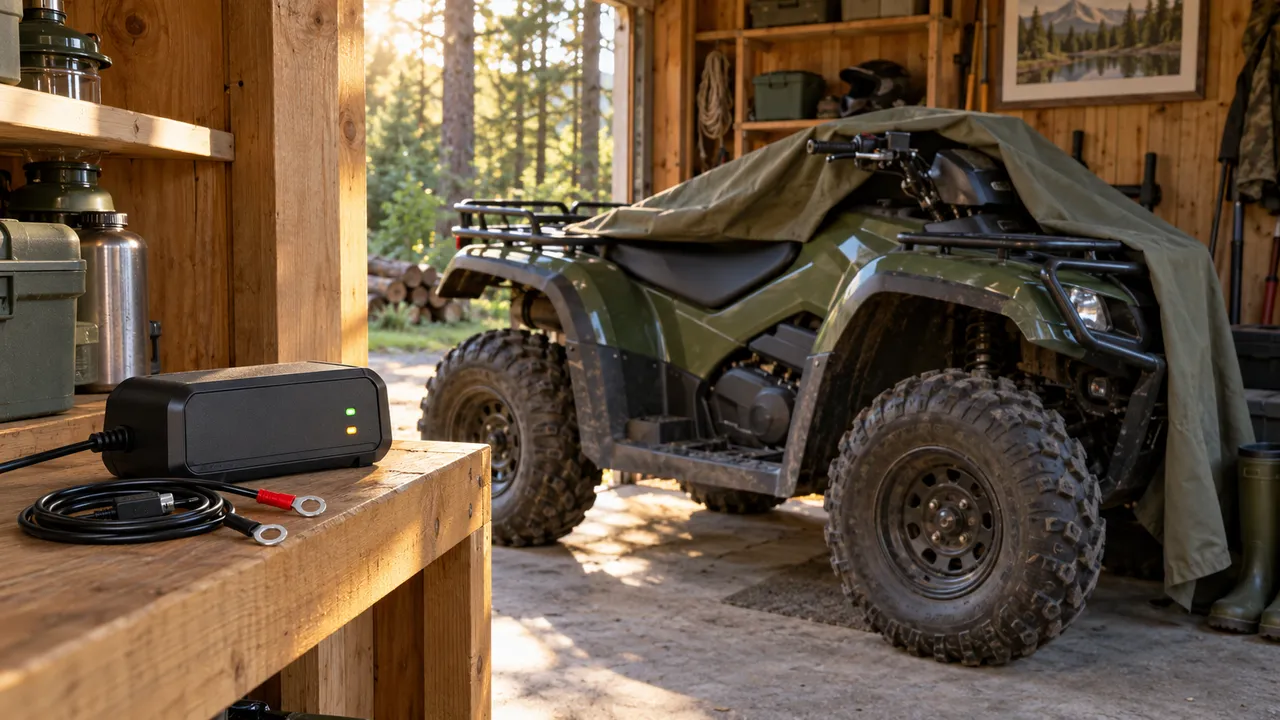
The best ATV trickle charger for storage is usually an automatic battery maintainer matched to your battery’s voltage, chemistry and permitted charging current. Our shortlist is the NOCO GENIUS1 for selectable charging modes, Battery Tender Junior 750mA for straightforward lead-acid maintenance, and CTEK US 0.8 for low-current lead-acid charging with pulse maintenance. Check the exact battery instructions before choosing.
Our ATV charger picks

NOCO GENIUS1
1A smart charger with 6V and 12V modes, including dedicated AGM and lithium settings. Best suited to owners who need more than one charging profile.
Shop on Amazon ↗
Battery Tender Junior 12V 750mA
Automatic 0.75A charger and maintainer for compatible 12V lead-acid, AGM and gel batteries. This 750mA model is not the lithium-selectable Junior.
Shop on Amazon ↗
CTEK US 0.8 (56-865)
0.8A automatic 12V lead-acid charger with a six-step cycle and float/pulse maintenance. A compact option for seasonal powersports storage.
Shop on Amazon ↗Trickle charger vs battery maintainer: what matters for an ATV?
A traditional trickle charger supplies a small continuous charging current. An automatic battery maintainer manages charging and maintenance according to its design. For an ATV parked between rides, look for that controlled maintenance behavior rather than choosing from the word “trickle” on the listing alone.
Retailers often use trickle charger, float charger and smart charger together. Read what happens after the battery is fully charged: does the device switch to a storage stage, monitor voltage or provide pulses when required? An unregulated charger can overcharge a battery if left connected beyond its intended use.
Battery Tender is a brand, not a universal name for every maintainer. A Battery Tender for an ATV still needs to match the installed battery. The same applies to a NOCO or CTEK charger, including any motorcycle or powersports model with a familiar-looking connector.
How we choose the best ATV trickle chargers
These picks compare documented charging profiles, low-current output, battery-capacity ranges and storage-maintenance features. They serve different needs rather than winning a single speed contest. They are specification-based recommendations; we have not conducted a hands-on comparison test.
The comparison covers small starting batteries used in gasoline ATVs. It does not cover electric ATV traction packs. Match the charger to the battery label and instructions, then compare lead length, connection method and the place where you will store the quad.
| Charger | Output and battery range | Best use |
|---|---|---|
| NOCO GENIUS1 | 1A; 6V/12V; charging up to 30Ah | Selectable lead-acid, AGM and approved lithium profiles |
| Battery Tender Junior 750mA | 0.75A; 12V; 3–30Ah lead-acid | Simple lead-acid, AGM or gel maintenance |
| CTEK US 0.8 | 0.8A; 12V; 1.2–32Ah lead-acid | Six-step charging with float/pulse maintenance |
NOCO GENIUS1: best for selectable battery charging modes
The GENIUS1 combines a 1A battery charger and maintainer with selectable modes for 6V lead-acid and 12V lead-acid, AGM and lithium batteries. NOCO specifies charging batteries up to 30Ah. It is a useful shortlist option if your garage includes different supported battery types.
Select the correct mode before charging your ATV battery. Lithium use requires an appropriate battery management system and approval from the battery maker. Do not assume that a recovery or force setting is suitable because normal charging has failed. A maintainer is also different from a jump starter: it will not supply the starter’s immediate cranking power.
Battery Tender Junior 750mA: best for simple lead-acid storage
The Battery Tender Junior 12V 750mA is an automatic charger and maintainer for lead-acid batteries, including AGM and gel, in its stated 3–30Ah range. Its storage-maintenance function makes it a straightforward candidate when you want to keep a compatible battery charged between rides.
Choose the exact 750mA model deliberately. Other Junior versions have different output ratings and selectable chemistry; their lithium support does not transfer to this model. The included alligator clips and ring-terminal arrangement provide different connection choices, subject to the vehicle’s installation instructions.
CTEK US 0.8: best for low-current lead-acid pulse maintenance
The US 0.8 delivers up to 0.8A and charges 12V lead-acid batteries from 1.2–32Ah. CTEK lists flooded, maintenance-free, AGM and gel support. Its six-step cycle includes float and pulse maintenance; the manufacturer specifies maintenance charging up to 100Ah.
This is a lead-acid option, not a lithium charger. The US model’s mains input also differs from regional XS variants, so check the model number and plug rather than buying an apparently similar unit. Its IP65 rating does not remove the need to keep mains connections protected and follow the installation limits.
Match 12V, AGM or lithium before comparing charging speed
Start with nominal voltage and battery chemistry. Next check actual amp-hour capacity, the permitted charging current and the required profile. A higher-output charger is not automatically better for small ATV batteries. A lithium battery’s lead-acid-equivalent marketing figure is not necessarily its actual capacity.
The low-current picks here favor small-battery care and maintenance. Charging speed depends on the amount of charge missing and the charging stages, so there is no reliable universal overnight promise. A severely discharged or damaged battery may need testing instead of repeated charger changes.
Set up a battery maintainer for winter storage
Inspect the battery, terminals and charging lead first. Use a sound power source and the approved connection or charging port. Route the cable away from hot surfaces, moving parts and places where a cover or door can pinch it. Confirm connector polarity; fitting an adapter does not establish electrical compatibility.
Follow the charger and vehicle manuals for connection order and whether charging in the ATV is permitted. Check the indicator after starting the cycle, then inspect periodically during storage. Long-term use requires approval for that battery and environment; keeping your ATV battery charged is not a reason to leave a faulty setup unattended.
When a trickle charger will not fix a dead ATV battery
A battery maintainer supports battery maintenance; it does not repair a loose ground, starter fault or accessory draining power while parked. A battery that repeatedly loses charge needs a battery test and vehicle diagnosis, even if a charger temporarily brings the voltage back up.
If the charger reports an error, identify the message rather than bypassing protection. Check battery health, the lead fuse and the selected profile. Once the battery reaches full charge, repeated weak starts are a reason to test starting performance, not buy a more powerful charger without investigation.
Frequently asked questions
Can I leave an ATV trickle charger connected all winter?
Use an automatic maintainer for prolonged storage only when its instructions and the battery maker approve that use. A continuous unregulated trickle charger is not equivalent. Inspect the battery, leads and power connection periodically.
Is 750mA, 800mA or 1A best for an ATV battery?
The best current is one permitted by the exact battery. These are low-current options, but battery capacity and chemistry still determine suitability. More charging power is not a universal upgrade.
Can I use a Battery Tender Junior on a lithium ATV battery?
The 12V 750mA Junior listed here is a lead-acid model. For lithium, choose a charger explicitly approved for that lithium battery and verify the exact model’s chemistry settings.
Does a maintainer charge the battery or only keep it charged?
The three automatic charger-maintainers listed here can charge batteries within their specified ranges and then maintain them. Small output means recovery can be slow; a severely discharged battery may require testing or the manufacturer’s recovery procedure.
Bring it back to your ride
Find your ATV in the catalog, browse battery size references or explore the other field guides.