How to jump start an ATV with a portable jump starter
Learn when an ATV jump start is appropriate, how to check booster compatibility and what to test after the engine starts.
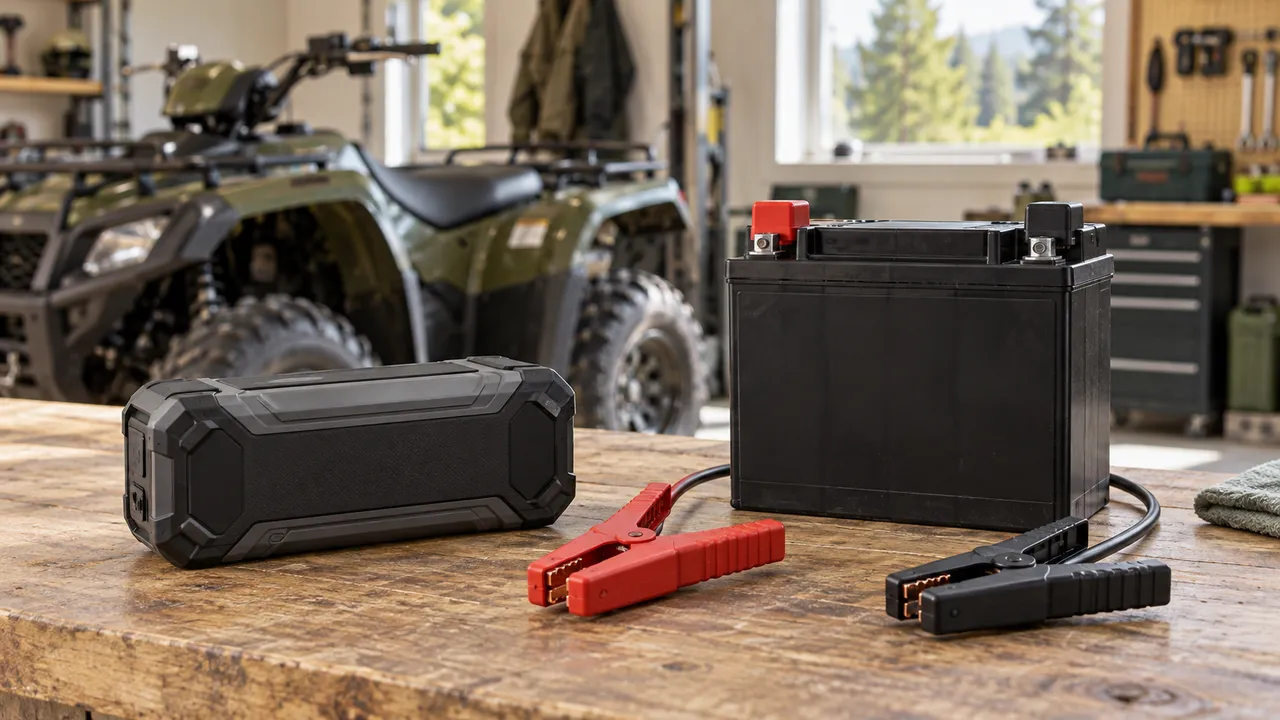
To jump start an ATV, first confirm that its manual permits boosting and that the booster supports the installed battery voltage and chemistry. Inspect the battery, secure the vehicle, and follow the exact connection, starting and removal instructions in both manuals. A successful jump start still needs a battery and charging-system check.
Portable jump starters to consider
These are portable boosters, not plug-in battery maintainers. Both models are intended for compatible 12V lead-acid starting batteries; confirm that your ATV permits boosting before choosing one.

NOCO Boost GB20
500A portable booster for compatible 12V lead-acid starting batteries. Check your ATV’s boosting procedure and clamp access. Its internal lithium battery does not make it a booster for an installed lithium ATV battery.
Shop on Amazon ↗
NOCO Boost GB40
1000A portable booster for compatible 12V lead-acid batteries, with a broader engine rating for owners sharing a pack across vehicles. Higher peak amps do not replace voltage, chemistry and connection checks.
Shop on Amazon ↗Decide whether the ATV needs a jump start
Listen to what happens when you press the starter. Slow cranking or repeated clicking may justify a battery check. An engine that turns normally but never fires needs a different investigation. Adding a booster does not resolve an empty fuel tank, an incorrect starting procedure or a mechanical fault.
Before getting cables out, record the symptom and check the normal controls in your owner’s manual. Confirm the stop switch, transmission position and required brake or clutch operation. This is especially useful when borrowing an unfamiliar ATV: starting controls vary between machines.
If the battery is accessible, inspect it without bridging terminals with a tool. Stop if the case is cracked, leaking, swollen, unusually hot or suspected to be frozen. Arrange testing or recovery rather than trying to force another start.
Choose a compatible ATV jump starter
Read the battery label and the portable jump starter documentation together. A battery pack containing lithium cells is not automatically suitable for boosting a lithium battery installed in the ATV. The pack’s internal chemistry and its approved target batteries are separate specifications.
Check nominal voltage, supported target chemistry, operating temperature and the vehicle applications the manufacturer allows. Confirm the pack is charged and the clamps can reach the approved connection points without pulling on cables. Do not choose solely by a large peak-amp number.
| Equipment | Check before use |
|---|---|
| Portable booster | Approved target voltage and chemistry; charged pack; readable instructions. |
| Donor battery and jumper cables | Permission in both vehicle manuals; matching voltage; suitable cables. |
| Battery charger | Useful for recovery at home; not a jump starter unless explicitly designed for it. |
Prepare the battery terminals, clamps and jumper cables
Park on firm level ground, secure the ATV as its manual requires, turn the ignition off and switch off accessories. Work with ventilation and adequate light. Remove loose jewelry and keep cables away from moving parts, hot exhaust components and sharp edges.
Find the specified positive battery terminal and negative connection or ground point before attaching anything. Keep clamp jaws apart and check the polarity markings rather than relying on cable color alone. A crowded battery compartment can make a clamp contact surrounding metal even when it is aimed at the correct terminal.
Use the precise connection order and activation procedure for your vehicle and booster. Pack instructions and donor-vehicle instructions can differ, including where the final ground connection belongs. If the manuals conflict or no permitted procedure is given, obtain manufacturer guidance before continuing.
Make a controlled starting attempt
After the prescribed connections and checks, use the ATV’s normal starting procedure. Observe the cranking-time and cooling limits in both manuals. Stop for a booster fault indication, smoking, hot cables or unexpected behavior; repeated attempts are not a diagnostic shortcut.
Do not bridge a starter relay or defeat a brake, neutral or other interlock. If the starter remains silent with an approved booster attached correctly, investigate the starting circuit instead of increasing the available current.
Avoid force modes on an unidentified battery
Some jump packs offer a manual override that disables protective functions. Do not use this to experiment with an unknown battery or to bypass the protection system of a lithium ATV battery. A protection shutdown calls for the battery maker’s approved recovery procedure.
If the pack will not recognize the battery, recheck compatibility and connection points with the power off according to its instructions. Seek service when the cause remains unclear. Carrying a small instruction card for the exact pack is more useful than memorizing a generic cable sequence.
Check the battery after the ATV starts
Remove the equipment exactly as instructed and reinstall terminal covers and access panels. A running engine does not establish that the battery is healthy or fully charged. Back at the garage, use the correct charger and arrange a battery test if starting trouble continues.
Record whether the problem followed storage, accessory use or an earlier charging fault. Charge and test before replacing parts. If replacement is necessary, use the exact model, year and trim to identify the correct battery rather than treating the emergency booster as a permanent solution.
Frequently asked questions
Can I use a car battery to jump-start an ATV?
Only if the ATV and donor-vehicle instructions permit that method. Match voltage and follow their specified procedure, including donor-engine instructions. Do not assume a car-based procedure applies to every ATV.
Can a lithium jump pack boost an AGM ATV battery?
It can when the pack explicitly supports that voltage and lead-acid application. Its internal lithium cells do not determine which installed battery chemistries it can safely boost.
Will riding recharge a dead ATV battery?
Do not rely on a short ride to restore a deeply discharged battery. Check its charge status and use an approved charger after the emergency start; investigate repeated discharge.
Bring it back to your ride
Find your ATV in the catalog, browse battery size references or explore the other field guides.