ATV battery not charging: charger and vehicle diagnosis
Find why an ATV battery is not charging from an external charger or the vehicle. Check connections, battery condition, charging output and accessories first.
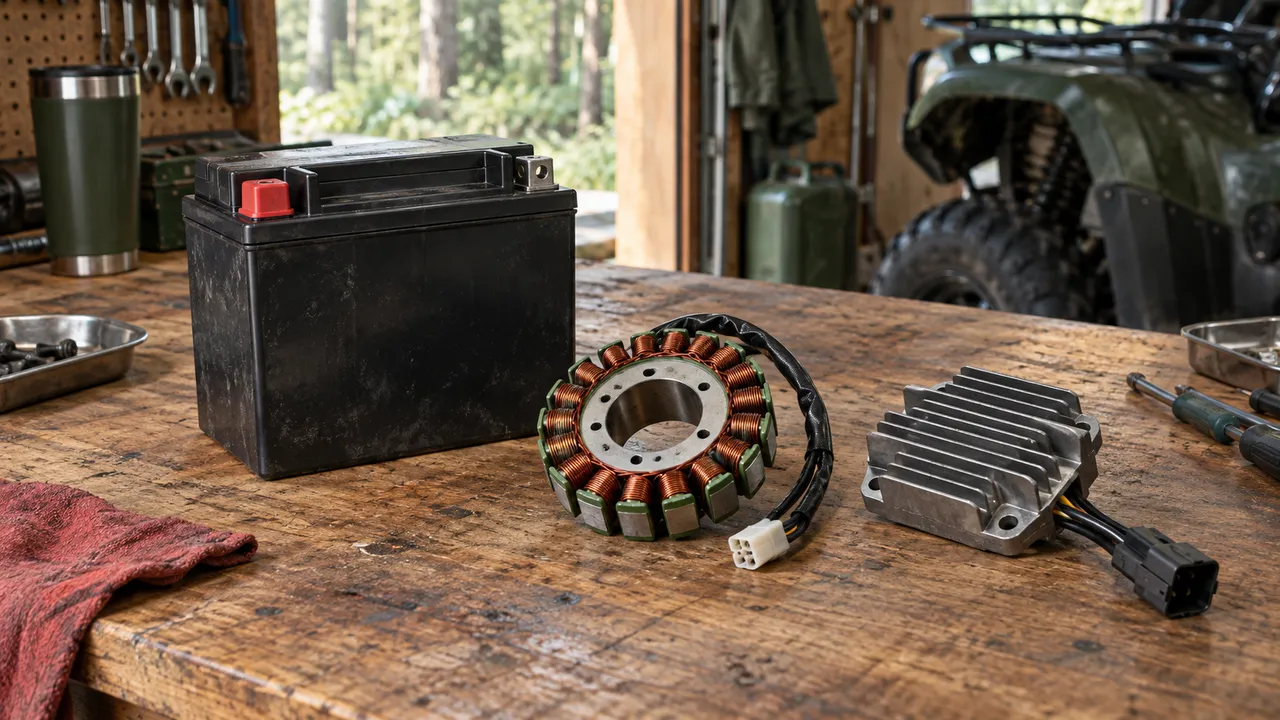
An ATV battery not charging can involve the external charger, the battery itself or the vehicle charging system. Identify which charging method is failing, check connections and battery condition, and use the correct chemistry profile. For vehicle diagnosis, compare running output with the service manual before blaming the stator or regulator.
Decide whether the charger or the ATV is failing to charge
Separate two symptoms: failure to accept an external charge, or loss of charge while the engine runs. Each requires a different diagnostic path.
Record what the charger actually reports. An error light, no connection indication and a completed-charge indication mean different things. Read the charger’s manual rather than translating every lamp into “bad battery.” Note the battery chemistry and charger model.
If the case is leaking, cracked or distorted, stop the charging attempt and arrange inspection or replacement. A damaged battery is not an appropriate starting point for repeated recovery experiments.
Check the external charger, socket and leads
Confirm the charger has power and that its connectors are fully seated. Check the accessible lead, ring-terminal connection and any inline fuse according to the charger instructions. A fault in a maintenance lead can prevent charging even when the battery terminals are secure.
Confirm nominal voltage, chemistry mode and permitted charging current. A charger suitable for a larger automotive battery is not automatically appropriate for a small powersports battery. Likewise, a lead-acid recovery or desulfation mode is not automatically approved for a lithium replacement.
Do not reverse polarity, bridge another battery into the circuit or defeat a charger’s protection to force detection. Use a battery-maker-approved recovery procedure or a qualified battery service when the charger refuses a deeply discharged battery.
Determine whether the battery accepts and retains charge
A charger displaying complete does not by itself prove that the battery can start the ATV. Follow the battery instructions for stabilization, then measure its rested voltage and check starting performance. Request an appropriate performance test if those results disagree.
A battery repeatedly subjected to deep discharge may have lost capacity. A lithium protection system can also change what the charger detects. Identify the actual battery type before interpreting either symptom; the recovery procedures are not interchangeable.
If a properly charged battery passes its test but loses charge when installed, examine vehicle charging and unwanted loads. If it fails testing, replacement may be necessary, alongside correcting the condition that discharged it.
Measure the ATV charging output under specified conditions
Begin with a sound, appropriately charged battery and secure connections. Measure DC voltage at the battery terminals, with the battery still connected. Record the engine-off reading, then perform the running test at the speed and load required by the vehicle service manual.
Compare with that model’s charging limits and the installed battery’s allowed charging range. An idle reading alone is insufficient to condemn the system. An output above the approved range is also a charging fault, even if the original complaint was a low battery.
Keep leads and clothing clear of moving and hot parts, and allow exhaust to disperse safely. Use a workshop if safe measurement is awkward.
| Finding | Next diagnostic step |
|---|---|
| External charger does not recognize the battery | Check connections, chemistry mode and approved recovery instructions. |
| Charger completes, battery struggles to start | Battery performance test and starting-circuit checks. |
| Running output below vehicle specification | Inspect charging-circuit connections and follow component tests. |
| Running output above the permitted range | Stop using the faulty charging system and inspect regulation. |
| Output meets specification, charge still falls | Evaluate battery condition, accessory demand and key-off drain. |
Inspect wiring before replacing the stator or regulator
The charging circuit includes more than its major components. Follow the wiring diagram to inspect accessible connectors, grounds and fuses. Look for heat damage, corrosion, loose pins or wiring affected by a previous repair.
Stator and voltage regulator/rectifier tests need the model-specific procedure. Resistance, AC voltage output and continuity checks have different setups. Follow the wiring diagram and identify the correct wiring harness connectors before testing the stator. Avoid generic resistance values and never measure resistance on an energized circuit.
Repair the identified fault, then retest under the original conditions. Changing several parts together obscures which one caused the problem.
Check accessory demand when the charging system passes
A functioning charging system can still face more demand than the riding pattern replenishes. Consider added lights, repeated winching, frequent starts and long low-speed operation. Compare accessory requirements with the vehicle’s documented electrical capacity.
If the battery instead loses charge after parking, investigate key-off drain. Keep that test separate from running-output diagnosis so an accessory left powered overnight is not mistaken for a failed stator.
Frequently asked questions
Does an ATV charge its battery while running?
A gasoline ATV with a functioning charging system supplies electrical power while running, but net battery charging depends on output, operating conditions and electrical demand. Use the vehicle’s test procedure to verify performance.
Can I disconnect the battery while running to test charging?
No. Keep it connected for the specified voltage test. Disconnecting it while running is not a valid charging-system diagnosis and can affect vehicle electronics.
Does a flat battery mean the stator is bad?
No. The cause may be battery condition, connections, charging regulation, an external charger problem or unwanted electrical demand. Test before replacing charging components.
Why will my charger not detect a lithium battery?
The charger may be incompatible or the battery protection system may have shut down its output. Follow the lithium battery maker’s approved charger and recovery instructions.
Bring it back to your ride
Find your ATV in the catalog, browse battery size references or explore the other field guides.