ATV battery cold weather care: winter starting and storage
Prepare your ATV battery for cold weather. Check winter starting problems, AGM and lithium charging limits, battery maintainers and seasonal storage.
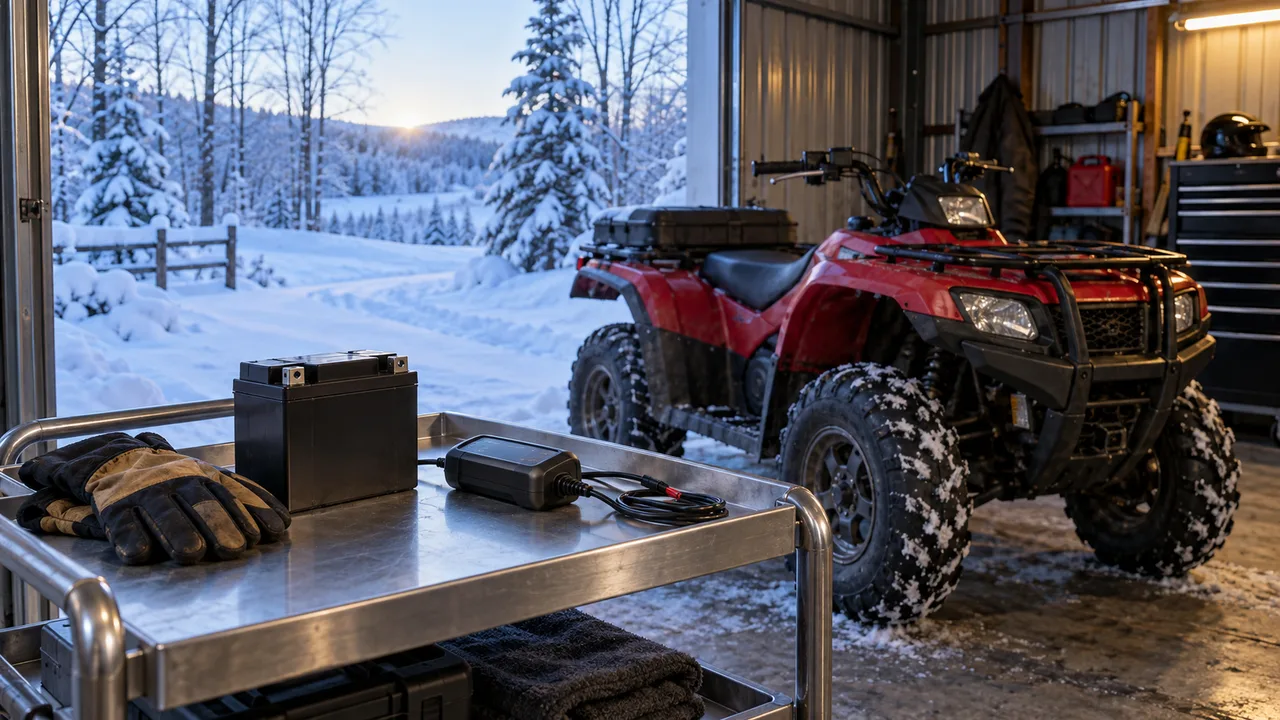
Prepare an ATV battery for cold weather by checking its condition, charge and cable connections before winter. Use a charger approved for its chemistry and temperature range, and plan for electrical drain while parked. For winter storage, follow the battery maker’s storage instructions; for winter riding, investigate weak starting before relying on the ATV far from home.
Chargers and maintainers to consider
Choose by battery chemistry, capacity and permitted charging current. The GENIUS1 offers selectable modes; the Junior 750mA and CTEK US 0.8 are lead-acid options. For lithium, confirm the battery maker approves the exact charger and temperature range.

NOCO GENIUS1
1A smart charger with 6V and 12V modes, including dedicated AGM and lithium settings. Best suited to owners who need more than one charging profile.
Shop on Amazon ↗
Battery Tender Junior 12V 750mA
Automatic 0.75A charger and maintainer for compatible 12V lead-acid, AGM and gel batteries. This 750mA model is not the lithium-selectable Junior.
Shop on Amazon ↗
CTEK US 0.8 (56-865)
0.8A automatic 12V lead-acid charger with a six-step cycle and float/pulse maintenance. A compact option for seasonal powersports storage.
Shop on Amazon ↗Why an ATV battery struggles in cold weather
A starting problem on the first cold morning can expose a marginal battery, a poor connection or an engine that is harder to turn. Cold-weather diagnosis needs more than the battery’s age. Compare the behavior with earlier starts: does the starter turn slowly, click without turning, or crank normally while the engine fails to fire?
Treat those as different paths. Slow cranking calls for battery and cable checks. Normal cranking with no ignition also needs fuel, ignition and starting-procedure checks. Repeated attempts can use up the remaining charge without addressing the original fault. Follow the vehicle’s starter duty limits and cold-start instructions.
A larger cold cranking amps number is not a shortcut around these checks. Battery fit, polarity, voltage and the required starting rating still need to match the ATV. Compare ratings measured on the same basis when choosing a replacement.
Check your ATV battery before the first winter ride
Make the inspection while you can still work comfortably in the garage. Look at the case, hold-down, terminal covers and cables. Stop using a battery with physical damage, leakage or swelling. Keep tools from bridging terminals, and follow the manual for access and any disconnection procedure.
For an undamaged battery, check charge using the procedure appropriate to its chemistry. Record the battery temperature and whether it has recently been charged or ridden. A single voltage reading is not a complete battery-health test; compare rested voltage, cranking behavior and charging output as separate observations.
Clean or repair a poor connection before deciding that the battery has failed. If the battery still struggles after a proper charge, arrange a suitable battery test. This gives you a useful decision before snow-plowing, hunting or trail riding places a higher demand on starting reliability.
AGM, flooded and lithium batteries need different winter care
Identify the installed battery from its label before choosing a winter charging plan. Maintenance-free and lithium are not interchangeable descriptions. An AGM battery uses lead-acid chemistry; a powersports lithium battery may use LiFePO4 and have separate operating, storage and charging limits.
For lead-acid batteries, charge matters to freezing risk: a discharged battery can freeze at a warmer temperature than a charged one. Do not charge or jump-start a frozen battery. An AGM battery stays sealed; a conventional flooded battery may need electrolyte checks according to its instructions.
For lithium, a temperature suitable for storage or discharge may still be unsuitable for charging. As one product-specific example, Antigravity’s RE-START powersports manual specifies charging from 0°C to 45°C (32°F to 113°F). Check your exact battery rather than applying that range to every lithium model. Do not assume a BMS includes low-temperature charging protection.
| Battery type | Winter check | Charger decision |
|---|---|---|
| Conventional flooded lead-acid | Condition, charge, vent routing and required electrolyte checks. | Use its approved voltage, current and charging profile. |
| AGM lead-acid | Charge, connections and secure mounting; leave the sealed case closed. | Check the charger’s documented AGM compatibility. |
| Lithium / LiFePO4 | Separate starting, storage and charging temperature limits. | Use a battery-maker-approved lithium charging profile and accessories. |
ATV battery winter storage checklist
Choose a storage arrangement that you can inspect easily. A battery left in the ATV needs a plan for vehicle electrical drain. A removed battery needs a secure location and protected terminals. Neither arrangement is automatically best for every ATV: check the vehicle and battery instructions together.
Write down the battery code, chemistry and charger model. Add the preparation date and the next inspection required by the manufacturer. A simple note makes it easier to distinguish a one-off low-charge reading from a continuing storage problem.
- Inspect the battery and cables; resolve damage or poor connections before storage.
- Follow the battery maker’s charge or state-of-charge instructions for storage.
- Decide whether to leave the battery installed, disconnect it or remove it using the vehicle’s specified procedure.
- Choose a dry, secure location within the battery’s storage temperature limits, away from ignition sources.
- Use an approved maintainer only when its instructions permit the intended connection and duration.
- Inspect on the manufacturer’s schedule and after an interruption to power or a charging fault.
Choose a battery maintainer for winter parking
Start with battery voltage, chemistry and capacity, then check charging-current and temperature requirements. A charger offering a lithium mode is useful only when the battery manufacturer approves that charger or charging profile. Temperature compensation for lead-acid charging is not the same function as preventing an unsuitable low-temperature lithium charge.
Look for clear charging and fault indicators, an approved connection method and a location that meets the charger’s environmental rating. Route leads so they cannot be pinched by the seat or caught by moving parts. A matching plug shape does not establish correct polarity.
Check what the charger does after the battery reaches full charge and whether continuous connection is permitted. An automatic maintainer can suit seasonal parking; an unregulated continuous trickle charger needs a different assessment. Compare documented features rather than choosing by the word smart on the package.
Winter riding, short trips and snow-plow accessories
Starting repeatedly, making short trips and using electrical accessories can change the balance between energy used and energy replaced. Record your actual pattern rather than assuming every ride fully recharges the battery. If starts weaken over several outings, inspect and test before the next remote trip.
For a winch, plow lift, heated grips or added lighting, check the vehicle maker’s accessory and charging-system limits. Do not treat a larger battery as a fix for inadequate charging output. An accessory that continues drawing power while parked can also undermine a winter storage plan.
If the same battery repeatedly loses charge, separate parked drain from charging faults and battery failure. A suitable maintainer may restore charge between outings, but it should not hide a wiring problem or a battery that no longer passes its required test.
Getting the ATV ready after winter storage
Before reinstalling or reconnecting the battery, inspect its condition and follow the specified charge and connection procedure. Confirm the hold-down, cable routing and terminal covers. Check any settings or vehicle procedures affected by disconnection.
Make the first start where you have tools and help available. If it cranks poorly or shows a charging fault, resolve that before heading onto the trail. If replacement is needed, use the exact model, year and trim to find the appropriate battery size and then compare products.
Frequently asked questions
What temperature is too cold for an ATV battery?
There is no single limit for every battery. Check separate operating, charging and storage ranges for the exact model. For example, the Antigravity RE-START manual permits charging only from 0°C to 45°C; other products may specify different limits.
What is the best ATV battery for cold weather?
Choose a documented match for your ATV with starting performance and temperature limits suited to your climate. Compare exact AGM or lithium products, required ratings and charging compatibility rather than selecting a universal winner by chemistry alone.
Can you bring a dead ATV battery back to life in winter?
An undamaged, discharged battery may accept a normal approved charge and then pass a battery test. Damage, freezing or a failed test needs a different response. Do not use force or repair modes without explicit approval for the battery and connection arrangement.
Should I remove my ATV battery for winter?
Follow the ATV manual and battery storage instructions. Removal can make inspection and controlled storage easier, but an installed battery can be appropriate when its environment, electrical drain and approved charging arrangement are managed.
Can I leave an ATV battery on a maintainer all winter?
Only when the battery and maintainer instructions allow the chemistry, charging profile, location and connection duration. Check it periodically as instructed and respond to power interruptions or fault indicators.
Will a fully charged ATV battery freeze?
Lead-acid freezing risk depends on charge, and a discharged battery is more vulnerable. Follow its storage limits rather than assuming full charge allows any temperature. Do not charge or jump-start a battery that may be frozen.
Are lithium ATV batteries good in cold weather?
Compare the exact product’s starting performance and operating range with your use. Check charging limits separately: acceptable cold-weather discharge does not automatically permit charging at that temperature.
Does briefly idling the ATV keep the battery charged?
Do not assume a short idle replaces the energy used to start or run accessories. Follow the vehicle’s storage instructions and use appropriate charge checks instead of an arbitrary idle routine.
Bring it back to your ride
Find your ATV in the catalog, browse battery size references or explore the other field guides.